
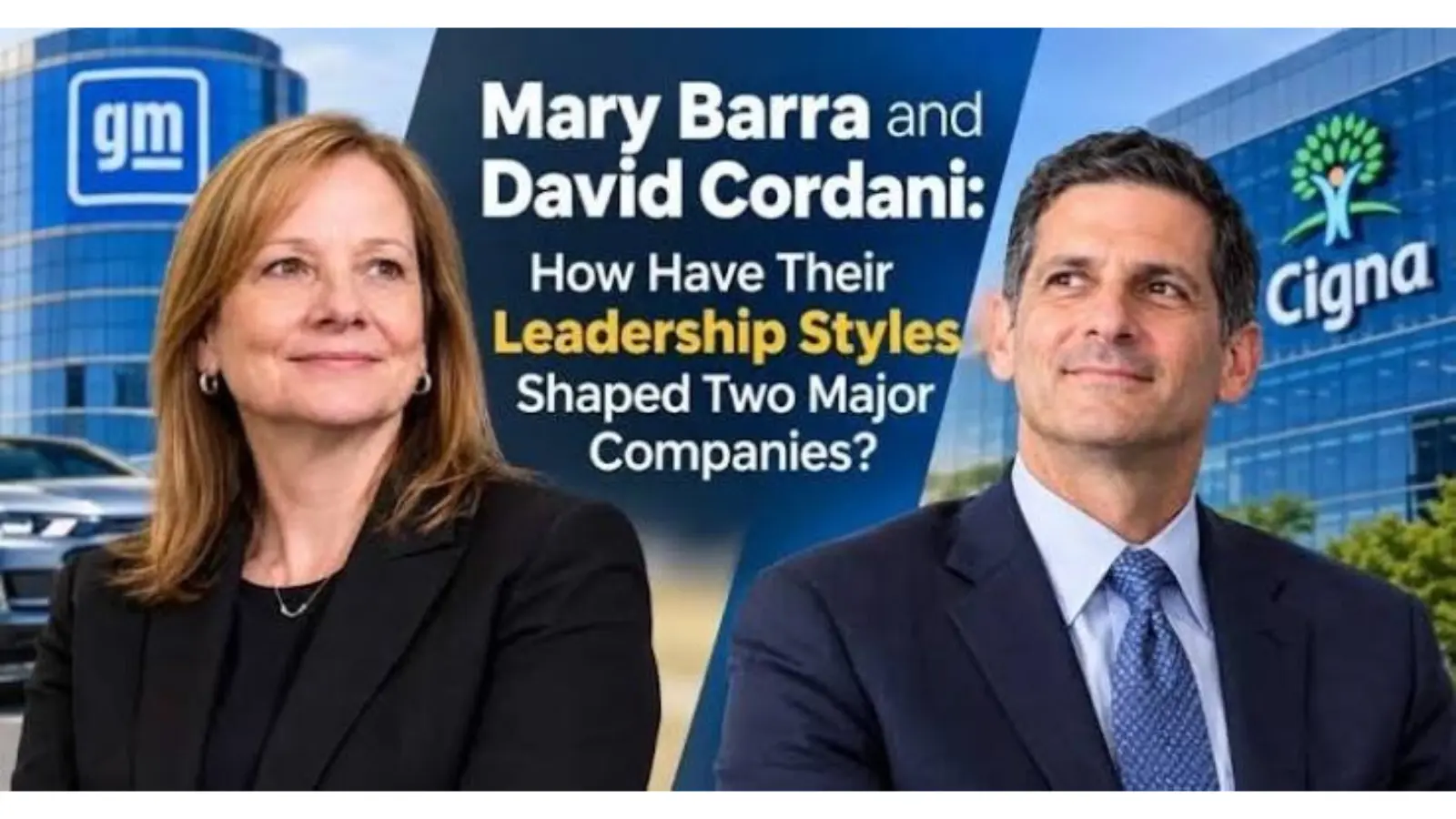
Mary Barra and David Cordani are two influential American business executives who built successful careers in different industries. Mary Barra is the Chair and Chief Executive Officer of General Motors (GM), while David Cordani is the Executive Chair of The Cigna Group. Both have spent decades developing their professional experience, managing major organizations, and navigating changes in their respective industries.
People searching for Mary Barra and David Cordani often want to understand who they are, whether they share a personal or professional connection, and how their careers compare. Although their names can appear together in discussions about corporate leadership, their publicly documented professional histories are separate. Barra is associated with automotive manufacturing and transportation technology, while Cordani has built his career in healthcare services.
Their stories provide an interesting comparison of executive development, business transformation, corporate strategy, and leadership succession. Understanding their individual backgrounds helps explain their positions in American business and the different responsibilities they have held throughout their careers.
1. Who Are Mary Barra and David Cordani?
Mary Barra is an American business executive who leads General Motors as its Chair and CEO. She became CEO in January 2014 and was elected Chair of the company’s board in 2016. Her career is particularly notable because she developed her experience within General Motors rather than joining the company directly in its highest executive position.
David Cordani is an American business leader who spent many years working at The Cigna Group. He joined the organization in 1991, became its president in 2008, and served as CEO from December 2009 until July 2026. He now serves as Executive Chair of the company’s board.
Both executives have worked in large organizations with extensive customer relationships and complex operations. However, their responsibilities differ because General Motors manufactures vehicles and develops mobility technologies, whereas The Cigna Group operates in healthcare services.
Their careers are connected by executive experience, not by an established business partnership or documented family relationship. This distinction is important for readers who want accurate information rather than assumptions based on two names appearing in the same search phrase.
2. Why Are Mary Barra and David Cordani Mentioned Together?
The combined search phrase Mary Barra and David Cordani raises a natural question: what connects an automotive executive with a healthcare industry leader?
The most useful way to understand the comparison is to consider their positions in American corporate leadership. Both spent substantial portions of their careers at major organizations, advanced through senior management positions, and eventually became responsible for important company-wide decisions.
Their professional backgrounds also make an interesting comparison because they represent different business environments.
Mary Barra’s career involves vehicle manufacturing, engineering, product development, supply chains, and technological innovation. David Cordani’s career involves healthcare management, customer relationships, health services, organizational strategy, and business development.
There is no established reason to assume that appearing together in an online article or search result means that the executives have worked together.
A responsible discussion should therefore focus on their independently documented achievements and explain the difference between a professional comparison and a verified personal or business connection.
3. Is There a Personal or Professional Relationship Between Mary Barra and David Cordani?
One of the most important questions surrounding this keyword is whether Mary Barra and David Cordani are related, married, or connected through business activities.
Based on the publicly available biographical and corporate information reviewed, no reliable evidence establishes that they are relatives, spouses, business partners, or participants in a documented joint project.
Their professional histories identify different organizations and career responsibilities. Barra’s executive career is centered on General Motors, while Cordani’s long-term corporate experience is associated with The Cigna Group.
This does not prove that they have never met or interacted in a broader business environment. Senior executives may participate in conferences, corporate organizations, public discussions, and industry events without developing a formal partnership.
It is therefore important to use careful language when discussing their relationship.
The most accurate conclusion is that they are two separate corporate leaders whose careers can be compared, but a direct personal or professional relationship has not been established through the sources reviewed.
4. Mary Barra’s Early Career at General Motors
Mary Barra’s professional journey began in 1980 when she joined General Motors as a co-op student at the Pontiac Motor Division. This early experience introduced her to the practical side of automotive manufacturing and helped her develop an understanding of how a major vehicle company operates.
Her educational background also played an important role. She earned a Bachelor of Science degree in electrical engineering from General Motors Institute, now known as Kettering University, in 1985. In 1990, she completed an MBA at Stanford Graduate School of Business.
Barra gradually developed experience in several areas of GM’s operations. These included manufacturing engineering, human resources, product development, purchasing, and supply chain management.
Before becoming CEO, she held important executive responsibilities, including:
- Vice President of Global Manufacturing Engineering.
- Vice President of Global Human Resources.
- Senior Vice President of Global Product Development.
- Executive Vice President of Global Product Development, Purchasing, and Supply Chain.
These positions gave her experience beyond a single department. She gained knowledge of manufacturing operations, workforce management, product quality, and business planning.
Her career demonstrates how technical education and practical organizational experience can create opportunities for executive advancement.
5. How Mary Barra Became General Motors’ CEO
Mary Barra became Chief Executive Officer of General Motors in January 2014. Her appointment was significant because she became the first woman to lead a major global automobile manufacturer.
She was elected Chair of the GM Board of Directors in 2016, adding board-level responsibilities to her executive role.
Her leadership has involved managing a company operating in a competitive and rapidly changing automotive market. Vehicle manufacturers must balance product development, manufacturing costs, customer expectations, safety requirements, and technological investment.
Under Barra, GM has continued working on several major business priorities:
Electric vehicles: The company has invested in battery technology and electric vehicle development as transportation markets move toward electrification.
Software and digital services: Connected vehicle technology, software capabilities, and digital customer experiences have become important parts of the modern automotive business.
Manufacturing operations: Production efficiency, vehicle quality, supply chain management, and workforce capabilities remain central to the company’s performance.
Autonomous technology: GM has explored advanced driver-assistance and autonomous driving technologies as part of its broader mobility strategy.
These priorities involve considerable investment and business risk. Electric vehicle demand, global competition, manufacturing costs, and changing consumer preferences all influence strategic decisions.
An additional development is relevant to Barra’s current leadership status. On November 17, 2026, Reuters reported that GM was seeking potential outside CEO candidates while also considering internal successors. GM had not publicly announced a successor, and the company declined to comment on the reported search. As of November 20, 2026, Barra remains GM’s Chair and CEO. Any future leadership transition should be distinguished from a confirmed appointment.
6. David Cordani’s Professional Journey at The Cigna Group
David Cordani developed his career in healthcare and business management. He joined The Cigna Group in 1991 and spent decades progressing through different leadership responsibilities.
His career included positions involving customer segments, marketing, healthcare operations, and executive management.
He became President of Cigna in 2008 and Chief Executive Officer in December 2009. His appointment placed him in charge of an organization operating in a complex healthcare environment involving customers, employers, healthcare providers, and business partners.
Cordani earned a Bachelor of Business Administration from Texas A&M University and an MBA from the University of Hartford.
His professional experience included several senior positions:
- Senior Vice President of Customer Segments and Marketing.
- President of Cigna Healthcare.
- Chief Operating Officer.
- President of The Cigna Group.
- Chief Executive Officer of The Cigna Group.
- Executive Chair of The Cigna Group.
His career is an example of long-term professional development within one major organization. Rather than focusing on a single specialty, he developed experience across multiple business functions.
Cordani has also participated in nonprofit and community initiatives. He co-authored The Courage to Go Forward: The Power of Micro Communities, a book exploring the importance of relationships and supportive communities.
7. How David Cordani Helped Shape Cigna’s Business
During David Cordani’s time as CEO, The Cigna Group developed beyond its traditional identity as a health insurer into a broader global health services organization.
An important part of this development involved expanding the company’s health services capabilities and strengthening its business platforms.
Two names are particularly important when understanding Cigna’s structure:
Cigna Healthcare focuses on health benefits and related healthcare solutions for individuals, employers, and other customers.
Evernorth Health Services represents the company’s health services platform, which includes capabilities such as pharmacy services, specialty care, and related health solutions.
This distinction matters because The Cigna Group is not simply one conventional health insurance business. Its operations involve different services designed to support customers and healthcare stakeholders.
Cordani’s leadership emphasized several business priorities:
- Improving customer engagement and service delivery.
- Developing healthcare services and capabilities.
- Using data analytics and digital technology.
- Supporting organizational growth.
- Addressing healthcare affordability and accessibility.
- Building relationships across healthcare markets.
The company also reported significant growth during his CEO tenure. In its March 2026 succession announcement, Cigna described its development from an organization serving 46 million customers with $18 billion in annual revenue to a global health company serving approximately 180 million customer relationships with $275 billion in annual revenue.
These figures are company-reported measures from its announcement, and customer relationships should not be interpreted as the same thing as individual unique members.
8. David Cordani’s 2026 Leadership Transition and Brian Evanko
A major recent development in David Cordani’s career occurred in 2026.
On March 3, 2026, The Cigna Group announced that Brian Evanko would succeed Cordani as Chief Executive Officer, effective July 1, 2026.
Cordani transitioned from CEO to Executive Chair of the Board on that date. This change followed nearly 17 years of service as the company’s chief executive.
Brian Evanko had previously served as President and Chief Operating Officer of The Cigna Group. His earlier responsibilities included financial management, healthcare business leadership, and operational oversight.
The transition is important for understanding Cordani’s current position.
As Executive Chair, Cordani continues to serve at the board level, providing leadership and strategic perspective. However, the CEO role now belongs to Brian Evanko, who is responsible for leading the company’s executive operations.
This distinction prevents an important factual mistake: describing Cordani as Cigna’s current CEO would be outdated.
His transition also illustrates how large organizations plan leadership succession to maintain continuity while introducing a new chief executive.
9. Mary Barra vs. David Cordani: Career and Leadership Comparison
Mary Barra and David Cordani have different educational backgrounds, industry experience, and corporate responsibilities. Comparing their careers helps explain what makes each executive professionally distinctive.
| Comparison | Mary Barra | David Cordani |
|---|---|---|
| Organization | General Motors | The Cigna Group |
| Industry | Automotive | Healthcare services |
| Current position | Chair and CEO | Executive Chair |
| CEO appointment | January 2014 | December 2009 |
| Organization joined | 1980 | 1991 |
| Education | Electrical engineering and MBA | BBA and MBA |
| University education | Kettering University and Stanford | Texas A&M and University of Hartford |
| Career specialization | Engineering, manufacturing, product development | Healthcare, marketing, operations |
| Major business focus | Mobility and vehicle technology | Health services and customer solutions |
The comparison highlights two different routes to executive leadership.
Barra developed technical and operational experience within a manufacturing company. Her background helped her understand product development and the complex processes involved in building vehicles.
Cordani developed experience across healthcare management and business operations. His professional journey involved customer relationships, healthcare services, and organizational development.
Their careers demonstrate that executive leadership can develop through different educational and professional pathways.
10. Different Leadership Priorities in Automotive and Healthcare
Although both executives have managed major organizations, their industries require different strategic decisions.
For Mary Barra, automotive leadership involves product safety, manufacturing efficiency, supply chain stability, vehicle innovation, and competition in global transportation markets.
A decision about a new vehicle platform, battery investment, or manufacturing facility can affect suppliers, employees, dealers, customers, and the company’s long-term financial performance.
For David Cordani, healthcare leadership involves service accessibility, customer experience, pharmacy services, healthcare affordability, and relationships with employers and healthcare providers.
Healthcare businesses also operate within complex regulatory and policy environments. Their decisions can influence how individuals and organizations access health-related services.
These different responsibilities create distinct management challenges.
Barra must help GM balance traditional vehicle operations with technological transformation. Cordani’s leadership experience involved developing a healthcare organization capable of serving customers through a broader range of health services.
The comparison is useful because it demonstrates that strong executive management depends on understanding the specific conditions of an industry rather than applying identical strategies everywhere.
11. Their Influence on American Business and Corporate Leadership
Mary Barra and David Cordani represent two important parts of the American economy.
General Motors is a major participant in the automotive manufacturing industry. Its activities connect vehicle engineering, manufacturing facilities, suppliers, dealerships, technology providers, and international markets.
Barra’s position gives her responsibility for decisions that affect the company’s direction in a period of changing transportation technology.
The Cigna Group operates in the healthcare services industry, where business decisions can affect customers, employers, healthcare providers, and communities.
Cordani’s long tenure as CEO placed him at the center of significant changes in the company’s organizational structure and service capabilities.
Their professional experiences also offer useful lessons for people interested in corporate governance:
Industry expertise matters: Both executives developed substantial knowledge of their respective business environments.
Leadership development takes time: Their career paths involved years of professional experience before reaching the highest executive positions.
Organizations must adapt: Automotive and healthcare companies face changing technologies, customer expectations, and competitive conditions.
Succession planning is important: Cordani’s transition to Executive Chair and Brian Evanko’s appointment demonstrate the importance of leadership continuity.
Strategic decisions require accountability: Executives must consider employees, customers, investors, and the long-term health of their organizations.
12. What Their Professional Journeys Teach Future Business Leaders
The careers of Mary Barra and David Cordani provide practical lessons for students, managers, entrepreneurs, and aspiring executives.
Their backgrounds show that professional success does not depend on one educational subject or a single career path.
Barra’s journey highlights the value of technical education, operational experience, and understanding the people who develop and manufacture products.
Cordani’s career demonstrates how business administration, customer knowledge, and experience across different management functions can support long-term executive development.
Several lessons stand out:
- Develop expertise in the industry where you want to work.
- Gain practical experience instead of relying only on academic qualifications.
- Build communication and decision-making skills.
- Understand how different departments contribute to organizational performance.
- Stay informed about technological and economic changes.
- Take responsibility for both successful decisions and difficult challenges.
- Continue learning as professional responsibilities increase.
- Prepare for future leadership changes rather than focusing only on current positions.
Their journeys should not be treated as identical success formulas. Instead, they demonstrate how different professional strengths can contribute to leadership in complex organizations.
Frequently Asked Questions About Mary Barra and David Cordani
1. Who are Mary Barra and David Cordani?
Mary Barra is the Chair and CEO of General Motors, while David Cordani is the Executive Chair of The Cigna Group. Both are experienced American business executives with long careers in different industries.
2. Are Mary Barra and David Cordani related?
No verified public information establishes a family relationship between them. Their documented professional biographies describe separate careers in automotive manufacturing and healthcare services.
3. Are Mary Barra and David Cordani business partners?
There is no reliable public evidence establishing a direct business partnership or joint project between the two executives. Their careers are associated with different companies.
4. What company does Mary Barra lead?
Mary Barra leads General Motors as its Chair and Chief Executive Officer. She became CEO in January 2014 and was elected Chair in 2016.
5. Is David Cordani still the CEO of Cigna?
No. David Cordani transitioned from CEO to Executive Chair of The Cigna Group on July 1, 2026. Brian Evanko succeeded him as CEO.
6. What did Mary Barra study?
Mary Barra earned a bachelor’s degree in electrical engineering from General Motors Institute, now Kettering University. She later completed an MBA at Stanford Graduate School of Business.
7. What are David Cordani’s educational qualifications?
David Cordani earned a Bachelor of Business Administration from Texas A&M University and an MBA from the University of Hartford.
8. What industries do Mary Barra and David Cordani represent?
Mary Barra represents the automotive and mobility industry through General Motors. David Cordani represents healthcare services through his long executive career at The Cigna Group.
9. Who replaced David Cordani as Cigna CEO?
Brian Evanko became CEO of The Cigna Group on July 1, 2026, succeeding David Cordani.
10. Is Mary Barra leaving General Motors?
As of November 20, 2026, Mary Barra remains General Motors’ Chair and CEO. Reuters reported on November 17 that GM was exploring potential successors, but no successor had been publicly announced.
Conclusion
Mary Barra and David Cordani are two experienced American executives whose careers demonstrate different approaches to corporate leadership. Barra has spent decades at General Motors, developing expertise in engineering, manufacturing, product development, and automotive strategy. Cordani built his career at The Cigna Group, eventually leading its development as a broader healthcare services organization before becoming Executive Chair in July 2026.
Although their professional experiences provide an interesting comparison, no verified public evidence establishes a direct family relationship or business partnership between them. Their significance comes from their individual leadership journeys and contributions to two different industries.
For readers interested in business careers, executive management, and organizational transformation, their stories offer useful examples of how education, experience, strategic thinking, and professional development can shape long-term leadership.

Mia Giggles light-hearted humor aur relatable daily life jokes likhti hai. Is ki funny captions aur social media humor readers ko instantly entertain karta hai 😄